




Energy Efficient Agri and Aquaculture
Our heat exchangers help agricultural HVAC manufacturers develop more productive ventilation systems by reducing energy consumption, improving air quality, and increasing efficiency, compared with systems without heat recovery units.

Livestock Farming
Poultry houses, pig farms, and dairy barns.
Plant & Horticulture
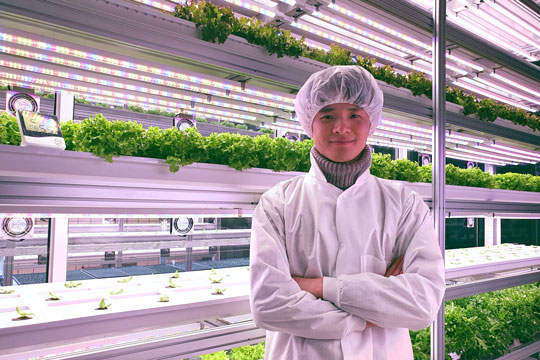
Greenhouses, indoor/ vertical farming, and crop storage.
Aquaculture Systems
Fish farms, hatcheries, RAS (recirculating systems).
Livestock Farming
Poultry houses, pig farms, and dairy barns.
Plant & Horticulture
Greenhouses, indoor/ vertical farming, and crop storage.
Aquaculture Systems
Fish farms, hatcheries, RAS (recirculating systems).
Heat Recovery in Agricultural HVAC
Feeding future generations requires innovation, and indoor farming is leading the way. Controlled Environment Agriculture (CEA) enables year-round production and resource efficiency, but its success depends on smart climate control. At the core of this is ventilation and heat recovery.
Ventilation ensures a healthy environment by removing harmful gases such as ammonia, methane, and carbon dioxide, controlling humidity, and reducing airborne pathogens. For plants, proper airflow supports photosynthesis and prevents disease. For animals, it ensures comfort and reduces respiratory risks. Poor ventilation can lead to stress, reduced productivity, and increased health issues.
Indoor farms generate significant heat from lighting, equipment, and biological activity. Instead of wasting this energy, modern systems capture and reuse it. Heat recovery ventilation reduces heating and cooling demands, lowers energy costs, and minimizes environmental impact, making climate control both sustainable and cost-effective.
Passive ventilation may be economical, but active systems with heat recovery deliver precision. Automated solutions maintain ideal temperature, humidity, and CO₂ levels regardless of season. This ensures optimal growth conditions for plants and animal welfare while reducing energy consumption.
Smart ventilation and heat recovery systems are essential for meeting the unique demands of modern indoor farming.
Since agricultural HVAC equipment accounts for a significant share of total energy use, selecting energy-efficient components can yield substantial savings in energy and operating costs. The goal is to optimize animal or plant well-being and growth while minimizing the marginal cost of energy usage.
An air-to-air heat exchanger reduces the load on air conditioning by conserving energy during cooling and dehumidification, thereby increasing system efficiency and lowering operational costs.
Both rotary and plate heat exchangers are suitable for indoor agriculture.
All our heat exchangers are made of aluminum, which has excellent properties such as efficient heat transfer, dehumidification, and an exceptionally long lifespan. For installations in corrosive environments, we can offer options such as epoxy-coated heat transfer plates and a corrosion-protected framework in Aluzinc, stainless steel, or polyester powder coating, depending on the product category.
Heatex high-performance air-to-air heat exchangers offer numerous design variables and options, enabling a perfect fit and performance in every air handling unit (AHU).
Using our product selection software, Heatex Select enables accurate calculations of our products’ performance under different conditions.
Air-to-Air Heat Exchangers for Agriculture Ventilation
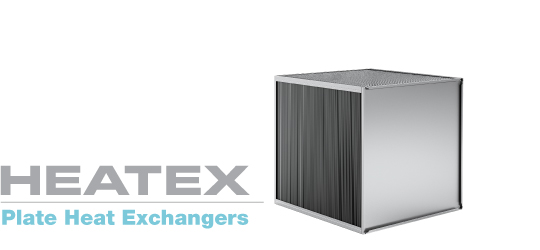
Heatex Model H2 & Model H
Heatex plate heat exchangers enable heat transfer and have less leakage than rotary heat exchangers.
Typical options in agricultural ventilation applications include:
- Epoxy-coated heat transfer plates for improved corrosion protection
- Lacquered plate edges for corrosion protection
- Corrosion-protected framework
- Aquaseal – for water tightness and an even higher level of air tightness
- Different profiles for customized installation
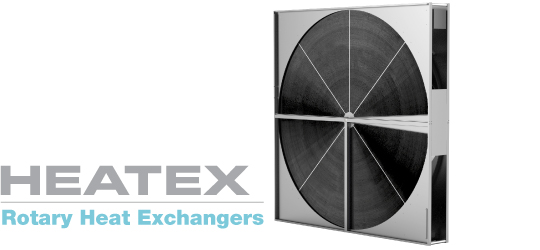
Heatex Model E & ES
Heatex rotary heat exchangers enable humidity transfer and generally provide higher efficiency than plate heat exchangers.
Typical options in agriculture ventilation applications include:
- Segmented (sectorized) wheel and casing (Model ES only)
- Stainless steel shaft and bearings (permanently lubricated and sealed)
- Corrosion-protected framework
- Molecular sieve-coated aluminum matrix
Ask an Expert
We strive to understand our customers’ challenges in indoor agriculture HVAC and provide the best solutions and services for each project. Our skilled, experienced application engineers support you throughout the development process.
Contact Us

Proven Technology
Heatex plate heat exchangers are operating in many types of agricultural air handling units.

Solid Track Record
Many years of experience supplying heat exchangers for industrial ventilation applications.

Extensive Capabilities
With production facilities in Europe, the US and China we are always close and accessible.
Proven Technology
Heatex plate heat exchangers are operating in many types of agricultural air handling units.
Solid Track Record
Many years of experience supplying heat exchangers for industrial ventilation applications.
Extensive Capabilities
With production facilities in Europe, the US and China we are always close and accessible.