




Dehumidify with Heat Exchangers
Our heat exchangers help industrial HVAC manufacturers achieve efficient moisture removal while maintaining stable temperatures by reducing energy consumption and increasing system reliability —unlike conventional systems that rely on energy-intensive processes with limited heat recovery.

Manufacturing & Processing
Food production, pharmaceutical and electronics manufacturing.
Storage & Logistics
Warehouses, packaging/ distribution areas, and cold storage.
Controlled & Critical Environments
Cleanrooms, laboratories, ice arenas, and indoor pools.
Manufacturing & Processing
Food production, pharmaceutical and electronics manufacturing.
Storage & Logistics
Warehouses, packaging/ distribution areas, and cold storage.
Controlled & Critical Environments
Cleanrooms, laboratories, ice arenas, and indoor pools.
Heat Recovery and Industrial Dehumidification
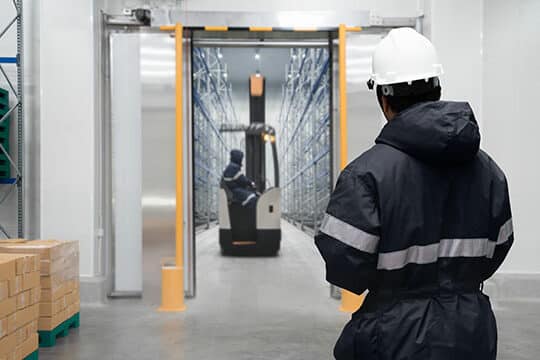
Particularly in industrial warehousing and food processing, operators often face a pressing need to control air humidity between spaces. The colder the climate, the more critical it is to control moisture. Traditional strip curtains and high-speed doors lead to energy loss and pose significant hurdles for transport. However, energy consumption is a primary concern in the design of a dehumidification system. Most of the energy expended in dehumidification is used to remove moisture from the air.
Combining an industrial dehumidifier with a heat recovery unit is a perfect win-win solution for addressing humid-air issues while significantly reducing energy consumption. Some common challenges are:
- Moisture enters the cold store from outside through the open passage (natural heat transfer).
- Moisture is removed via the evaporators’ outlets. However, if the evaporators are not frequently defrosted, they lose their capacity to remove large amounts of moisture.
- Depending on the method used, defrosting requires time and energy.
- Moisture entering the cold store can cause slippery floors, mold, corrosion, electrical malfunctions, and deterioration of product quality.
By implementing a heat-recovery unit, such as an air-to-air heat exchanger, heat from the regeneration process is recirculated and reused in the subsequent regeneration of the dehumidifier. Heat transfer occurs without moisture transfer.
As a result, heat is retained during the dehumidifier’s regeneration, minimizing energy consumption in the industrial dehumidification process.
Besides ensuring that as much heat as possible is transferred from the exhaust air to the supply air (>80%), the heat exchanger should provide:
- Low maintenance requirements
- Long lifespan (>15 years)
- Limited pressure drop < 500 Pa (2″ WC)
- Corrosion resistance
- Fast return on investment
Heatex’s crossflow heat exchangers feature a lightweight construction, slim frames, and an optimized plate pattern, delivering superior efficiency while maintaining a low pressure drop.
Our expertise in designing optimized heat exchangers for industrial dehumidification systems ensures that our customers achieve precise humidity control, maximum energy efficiency, and long-term reliability.
With our Heatex Select software, you can accurately calculate product performance under varying operating conditions, ensuring the optimal heat exchanger configuration for dehumidification applications.
Air-to-Air Heat Exchangers for Industrial Dehumidification
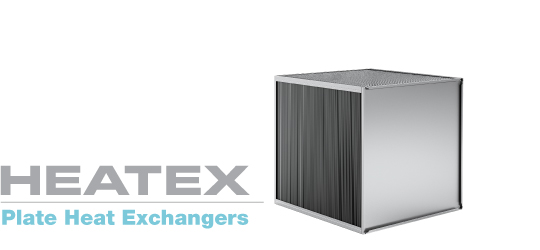
Heatex Model H & H2
Heatex crossflow models H2 and H are made of aluminum heat transfer plates and Aluzinc end plates.
Additionally, we offer a wide range of configurations and options, such as:
- Epoxy-coated heat transfer plates
- Corrosion-protected framework
- Plate distances between 1.6 – 12 mm (0.063″ – 0.47″), depending on the model
- Sizes between 200 – 3000 mm (7.9″ – 118″), depending on model
- Max. differential pressure between 1800 – 3000 Pa ( 7.22 – 12.04″ WC), depending on plate distances and model
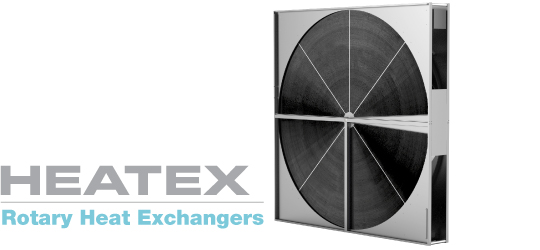
Heatex Model E & ES
Heatex rotary heat exchangers enable humidity transfer and generally provide higher efficiency than a plate heat exchanger.
Typical options for dehumidification applications include:
- Epoxy-coated matrix
- Corrosion-protected framework
- Power belt for high reliability, easy maintenance, and adjustment
- Various motor options. E.g., a constant motor for simplicity or a step drive motor with frequency control and Modbus for flexibility
- Double rotor setup for both dehumidification and heat recovery
Case Study in Industrial Dehumidification
Air in Motion B.V. has developed solutions for managing the moisture load in cold stores and cold storage for many years, developing in-house customized solutions specific to their client’s needs for industrial air drying.
Read Case Study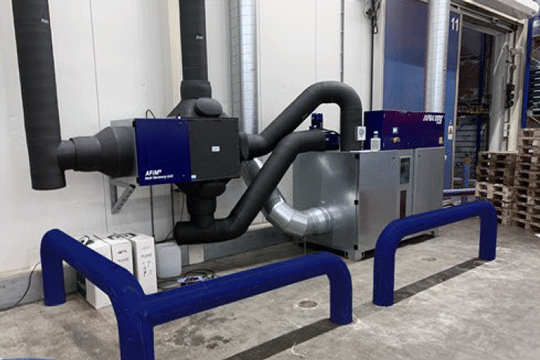
Ask an Expert
Need help with industrial dehumidification? Our experts can guide you in selecting the right heat recovery solution to reduce energy costs, improve humidity control, and optimize system performance. Contact us for tailored advice and accurate product configuration.
Contact Us

High-Efficiency Products
Certified performance for maximizing energy and heat recovery with a fast return on investment.

Technical Expertise
Extensive technical knowledge and solutions for your industrial dehumidification needs.

Global Capabilities
With production facilities in Europe, the US, and China, we are always close and accessible.
High-Efficiency Products
Certified performance for maximizing energy and heat recovery with a fast return on investment.
Technical Expertise
Extensive technical knowledge and solutions for your industrial dehumidification needs.
Global Capabilities
With production facilities in Europe, the US, and China, we are always close and accessible.