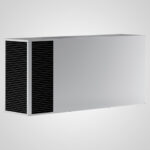
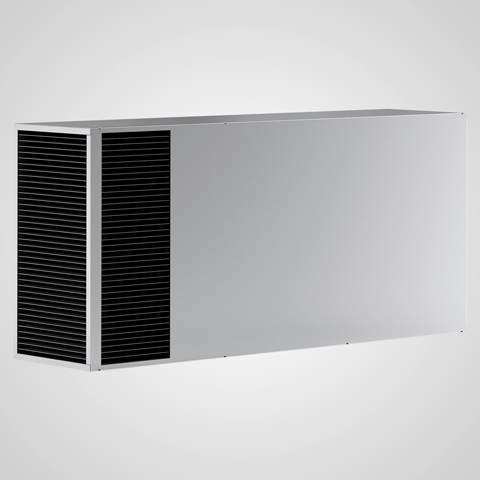
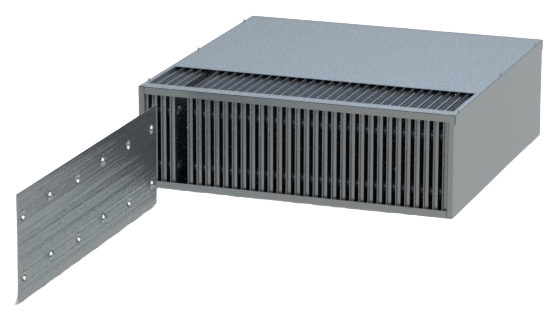
grey counterflow heat exchanger
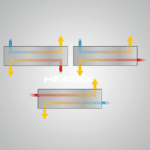
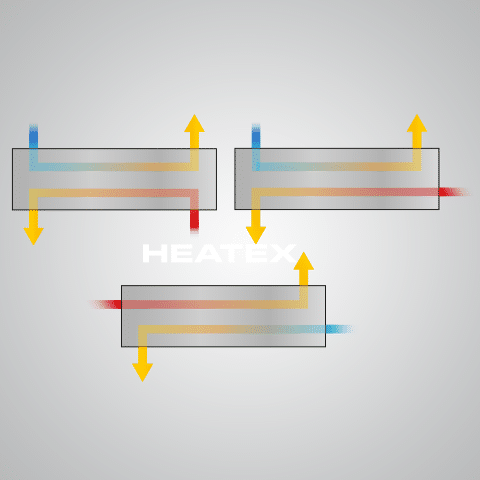
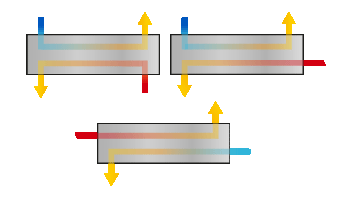
airflow configuration illustration
grey counterflow heat exchanger
airflow configuration illustration

Counterflow Heat Exchangers

Heatex counterflow heat exchangers combine a slim, effective counterflow design with different airflow configurations.


High Efficiency
High Efficiency

Coming close to 90% (sensible) efficiency, even in a dry situation.

Flexible Airflow Configurations

Ensuring an optimal solution for virtually any application.

Slim Design
Slim Design

For fitting in tight and compact spaces inside enclosures.

High Efficiency
High Efficiency

Coming close to 90% (sensible) efficiency, even in a dry situation.

Flexible Airflow Configurations

Ensuring an optimal solution for virtually any application.

Slim Design
Slim Design

For fitting in tight and compact spaces inside enclosures.

FEATURES OF THE COUNTERFLOW HEATEXCHANGER

Counterflow heat exchangers are particularly effective for heat transfer because they can leverage even small temperature differences. With their robust construction and high thermal performance, they are ideal for electronic cooling, demanding environments, and energy‑efficient heat recovery.

  • High‑efficiency function: Two counterflowing airflows maximize heat transfer.
  • Wide range of applications: Ideal for telecommunications cooling and inverter/converter cooling.
  • Technical reliability: Robust materials and stable performance during continuous operation.

CHOOSE YOUR COUNTERFLOW MODEL

Heatex Model M is a lightweight counterflow heat exchanger specifically developed for thermal management applications such as enclosure cooling.

Plate size
  • 95 mm (3.74″)
  • 140 mm (5.51″)
  • 190 mm (7.48″)
  • 235 mm (9.25″)
Width/ length 100 – 600 mm (3.94″-23.6″)
Heat transfer plate material
  • Aluminum
  • Epoxy-coated aluminum
Casing material Aluzinc
Airflow configurations
  • L+L
  • U+U
  • U+L
Max. differential pressure 700 Pa (2.81 in. WC)

OPTIONS FOR COUNTERFLOW HEAT EXCHANGERS

Besides being able to configure each heat exchanger in numerous ways in terms of size and performance requirements, we offer a wide range of options to suit various applications.

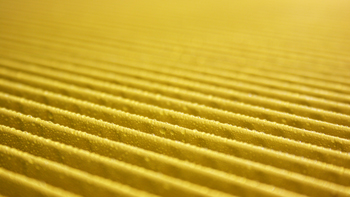
wet gold colored plates
Corrosion Protection

All Heatex aluminum heat exchangers are available with epoxy-coated plates for improved corrosion protection in demanding applications such as coastal environments.

Airflow Configuration

Model M is built according to customers’ requests with either a double L-flow, double U-flow, or L+U-flow configuration.

CUSTOM INTEGRATION SOLUTIONS

Especially for the Model M counterflow heat exchangers, Heatex offers custom integration solutions for easy installation and faster end-product delivery. Model M is built according to customers’ requests.

Contact Us
engineers working

APPLICATIONS FOR COUNTERFLOW HEAT EXCHANGERS

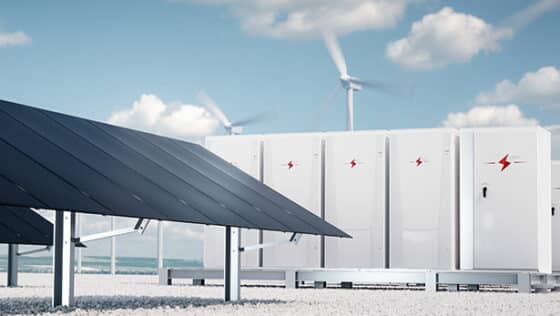
The Model M offers high energy efficiency and reliable performance in demanding environments. Thanks to its compact design and efficient heat transfer, it is used in a wide range of modern applications. It is particularly well‑suited for telecommunications equipment, digital media infrastructure, and solar energy and inverter cooling, where stable temperatures and energy‑optimized cooling are essential.

FAQ - Counterflow Heat Exchangers

How does a counterflow heat exchanger work?

A counterflow heat exchanger recovers heat between two air streams—usually supply air and exhaust air—that flow in opposite directions along the same heat‑transfer surface.

As warm exhaust air passes through the exchanger, it transfers its heat through thin plates to the colder incoming supply air, without the air streams mixing.

Because the air flows in opposing directions, a constant temperature difference is maintained across the entire exchanger.

What is the difference between a counterflow and a crossflow heat exchanger?

A counterflow heat exchanger maximizes thermal performance by guiding two air streams in directly opposite directions along the same, extended flow path. This opposite‑flow arrangement ensures that warm and cold air remain in contact over the entire length of the exchanger, creating a strong and continuous temperature gradient. The result is outstanding heat recovery, making counterflow units the top choice for high‑efficiency ventilation and cooling systems.

Unlike a crossflow heat exchanger, where the air streams cross each other at a 90‑degree angle, the counterflow design keeps the air streams aligned but moving head‑to‑head. This directional opposition dramatically increases heat transfer effectiveness but also requires greater installation depth and can lead to a higher pressure drop due to the extended channel length.

For applications where maximum energy recovery, reduced operating costs, and superior temperature approach are crucial, the counterflow airflow geometry delivers significantly higher performance than any crossflow configuration.

Can a counterflow heat exchanger be customized?

Yes, our counterflow heat exchanger can be customized for the application. As a manufacturer, we develop customized solutions tailored to our customers’ thermal requirements, environmental conditions, and structural specifications.

We offer adjustments in, among others:

  • Dimensions and geometry – for optimal integration into existing systems
  • Material selection – e.g., different aluminum alloys or surface treatments for corrosive or humid environments
  • Thermal design – based on airflow volumes, temperature differences, pressure drop, and the desired efficiency
  • Connection and mounting options – for quick and secure integration
  • Special requirements – such as for demanding environments, telecommunications systems, or inverter cooling

Thanks to this flexibility, we ensure each heat exchanger is optimally configured for its specific application—both technically and economically.

DOCUMENTS
Technical Documentation
  • Technical Information Pate Heat Exchangers

    EN, DE, FR

CONTACT US

We are here to support you.

Contact us