Casings for Large Airflows
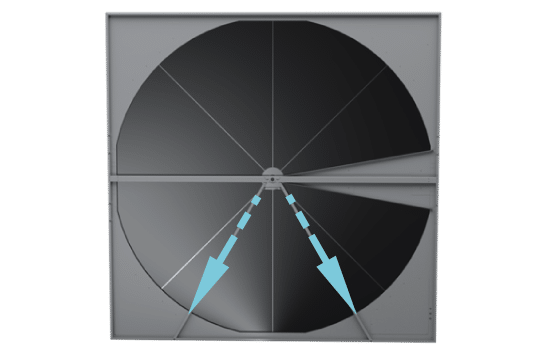
We reviewed our product offering, listened to customers and market feedback, and developed a modern casing specifically for large airflows, the Model E large casing.The casing has been reinforced, made fit for slide-in installation, and equipped with a wheel tilt function, diagonal motor placement, and large inspection hatches.
Large Airflows Require Purpose-Built Casings
As ventilation systems continue to evolve, the demand for high-performance heat recovery at high airflow rates is rapidly increasing. Modern commercial and industrial buildings require higher air volumes, driving the need for larger and more efficient rotary heat exchangers.
To meet these requirements, Heatex has developed a casing concept specifically designed for large-sized rotors, ensuring reliable performance without compromising installation flexibility or efficiency.
The casing is exclusively developed for large rotor dimensions, defined as: 1550 mm < height and width ≤ 2800 mm (approximately Ø1501–Ø2575).
These sizes are typically found in:
- Large air handling units (AHUs)
- Industrial ventilation systems
- High-capacity commercial buildings.
By targeting this segment, Heatex enables efficient heat recovery even in high airflow applications, where performance and durability are critical.
Large rotors require robust construction to maintain structural stability and long-term performance.
Heatex has:
- Conducted extensive long-term testing
- Verified both mechanical strength and tilt functionality
This ensures that the rotor maintains optimal operation over time, even under demanding conditions.
The large casing design has also been:
- Successfully evaluated by leading European customers
- Tested in real-world installations with large airflow demands
This confirms that the solution meets both technical requirements and market expectations. Heatex’s purpose-built large casings ensure performance, reliability, and efficiency—no matter the scale.
Effortless Wheel Adjustment
The rotor has a patent pending wheel tilt function. Minimize friction, leakage, and wear of the sealing by adjusting the wheel’s angle. Just expand or contract the turnbuckle to tilt the wheel.
Watch How To Adjust the Wheel Tilt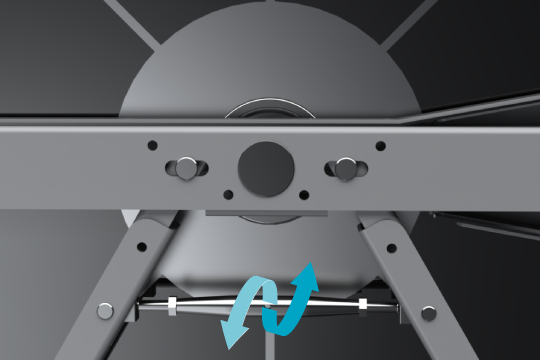
No Attachments Needed
The rotor is made ready for slide-in. No attachments are needed to hold the rotor in place as long as the air handling unit firmly supports the casing on all sides.
Even Load Distribution
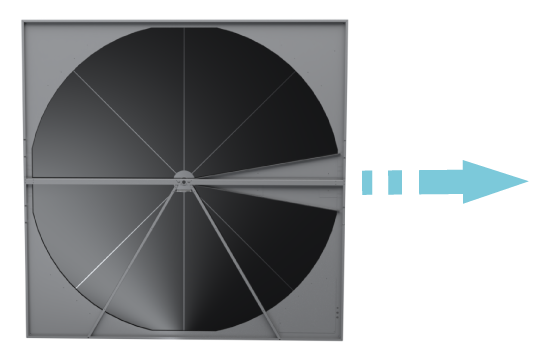
The load from the rotor is divided into two beams directing the forces toward the stronger structure in the corners. This results in a more even distribution of the load, which reduces the mechanical requirements of the AHU.